|
|
Consider the function $$ f(x) = 3x^4-4x^3-12x^2+3 $$ on the interval $[-2,3]$. We cannot find regions of which $f$ is increasing or decreasing, relative maxima or minima, or the absolute maximum or minimum value of $f$ on $[-2,3]$ by inspection. Graphing by hand is tedious and imprecise. Even the use of a graphing program will only give us an approximation for the locations and values of maxima and minima. We can use the first derivative of $f$, however, to find all these things quickly and easily.
Increasing or Decreasing?Let $f$ be continuous on an interval $I$ and differentiable on the interior of $I$.
Example
The function $f(x) = 3x^4-4x^3-12x^2+3$ has first derivative \begin{eqnarray*} f'(x) & = & 12x^3 - 12x^2 -24x \\ & = & 12x(x^2 -x - 2) \\ & = & 12x(x+1)(x-2). \end{eqnarray*} Thus, $f(x)$ is increasing on $(-1,0) \cup (2, \infty)$ and decreasing on $(-\infty,-1) \cup (0,2)$.
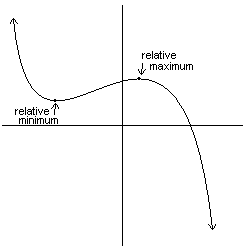
Relative Maxima and MinimaRelative extrema of $f$ occur at critical points of $f$, values $x_0$ for which either $f'(x_0)= 0$ or $f'(x_0)$ is undefined. First Derivative Test Suppose $f$ is continuous at a critical point $x_0$.
In summary, relative extrema occur where $f'(x)$ changes sign.
Example
Our function $f(x) = 3x^4-4x^3-12x^2+3$ is differentiable everywhere on $[-2,3]$, with $f'(x) = 0$ for $x=-1,0,2$. These are the three critical points of $f$ on $[-2,3]$. By the First Derivative Test, $f$ has a relative maximum at $x=0$ and relative minima at $x=-1$ and $x=2$. Absolute Maxima and Minima
ExampleSince $f(x) = 3x^4-4x^3-12x^2+3$ is continuous on $[-2,3]$, $f$ must have an absolute maximum and an absolute minimum on $[-2,3]$. We simply need to check the value of $f$ at the critical points $x=-1,0,2$ and at the endpoints $x=-2$ and $x=3$: \begin{eqnarray*} f(-2) & = & 35, \\ f(-1) & = & -2, \\ f(0) & = & 3, \\ f(2) & = & -29,\\ f(3) & = & 30. \end{eqnarray*} Thus, on $[-2,3]$, $f(x)$ achieves a maximum value of 35 at $x=-2$ and a minimum value of -29 at $x=2$. We have discovered a lot about the shape of $f(x) = 3x^4-4x^3-12x^2+3$ without ever graphing it! Now take a look at the graph and verify each of our conclusions.
Key Concepts
|